Encore! - The What and Why
The Encore! programme is evidence based to best provide a service that is not only enjoyable, but one that can truly help young people in the modern age. We believe that creativity is not just another attribute, but an integral part of well-rounded individuals.
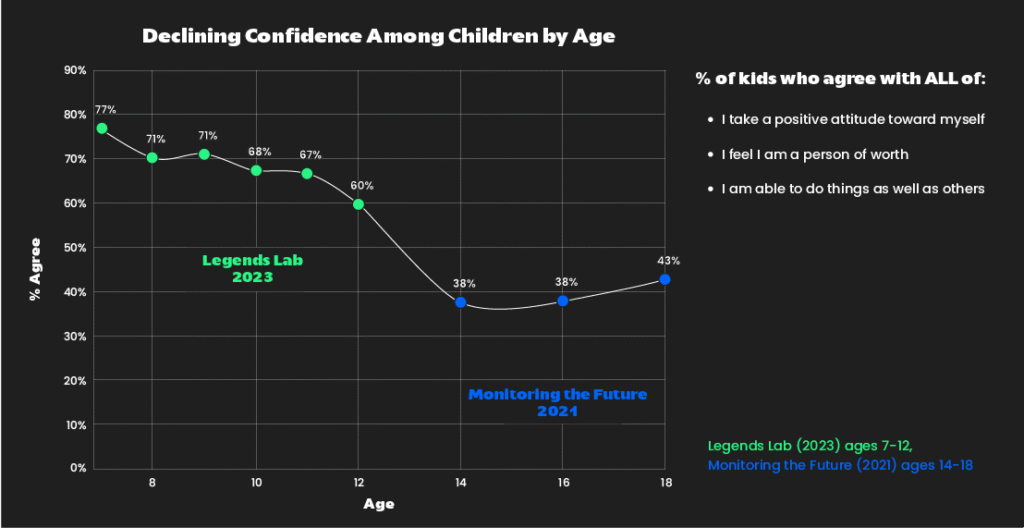
Hark’s ‘Listen Up Report’ raises the concern of a growing ‘confidence crisis‘ in our young people, reporting a statistic that, based upon their own studies, ‘1 in 3 young people have little or no confidence‘. This can be seen in a recurring phenomenon coined as ‘The Confidence Cliff‘ (see left). Brian Burkhard writes that ‘generally, kids are pretty confident until age 7 or 8, at which point there’s a decline in confidence… particularly among girls’. In a world dominated by perfectionism heightened by the popularity and success contest of social media, this trend is unfortunate, but not surprising. Hark’s report quotes Tom Campbell’s observation that ‘in schools this is stifling engagement, participation, freedom of expression and the opportunity to experiment with identity’.
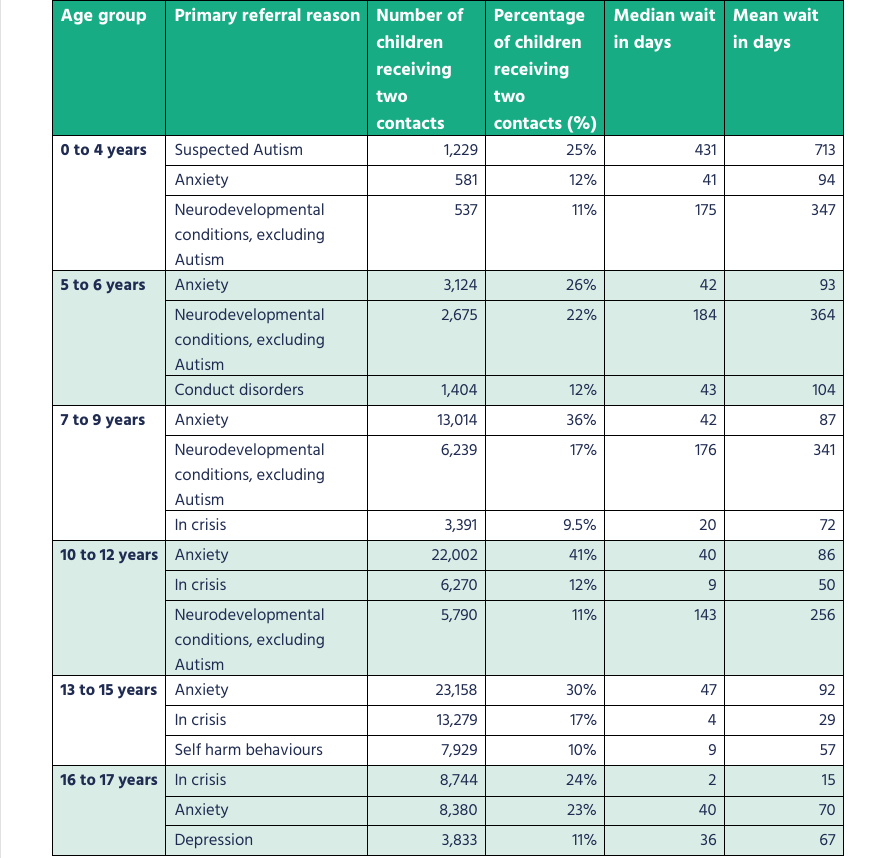
This goes beyond an issue of just confidence, unfortunately. Following the Covid-19 pandemic and its lockdown periods, there has been a spike in reported mental health concerns for young people. A Frontiers in Psychiatry article explains that young people ‘experienced social isolation from peers, teachers, extended family and community which increases the risk of developing mental health issues such as anxiety or depression’. The most recent Children’s Mental Health Report as produced by the Children’s Commissioner details the continually increasing trend of referrals to Children and Young People’s Health Services following the Covid-19 outbreak. Their statistics conclusively show anxiety as a dominant, if not the dominant reason for referrals (see right). The Government’s own report on the same corroborates that symptoms of loneliness, anxiety, and even PTSD ‘were found to have increased in children and young people aged between 7.5 and 12 years old compared to immediately before the pandemic’.
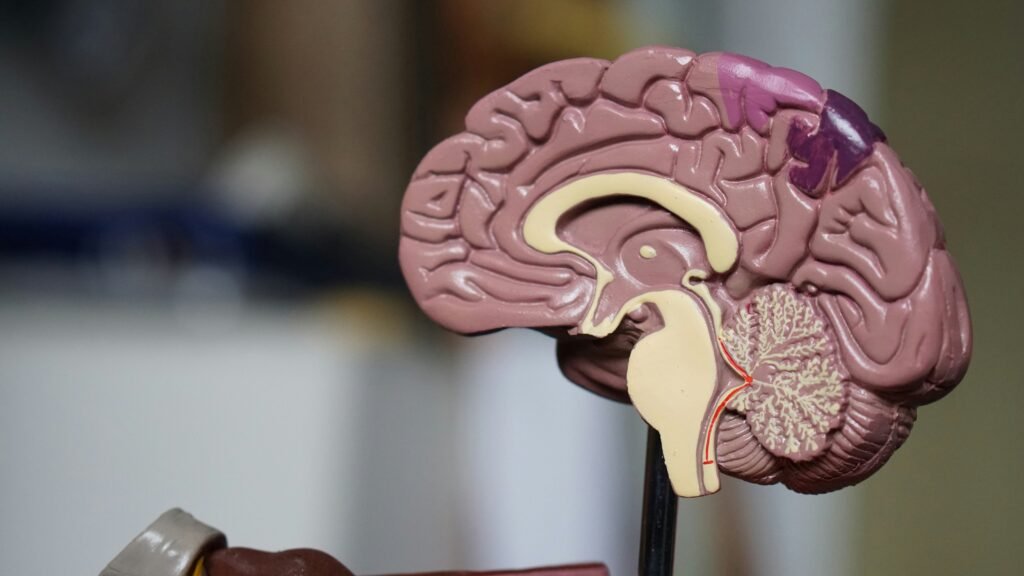
So, where does creativity and Encore! fit into this? Amanda Chadwick summarises what is a swathe of positive evidence like this: creativity and the arts ‘can provide safety, self-esteem, friendship, emotional understanding, empathy, and an opportunity to succeed which can allay anxiety and depression, make life worth living, and provide time in an otherwise ‘evidence based’, grade-hungry, tick box environment’. She goes onto emphasise the practical benefit of such programmes; ‘activities which promote well-being from an early age and recognise non-academic prowess could reduce the number of desperate parents and teenagers trying to get help from a badly funded mental health service with long waiting lists’. The evidence is overwhelming – the arts can combat things like anxiety staggeringly well. Daisy Fancourt has written extensively on this subject, and uses the scientific evidence to prove the point; ‘the arts are a very efficient workout, engaging diverse regions involved in sensory processing, memory movement, pattern recognition and emotions… regular arts engagement can strengthen connectivity between brain regions and even increase the volume of grey matter. In fact, amateur musicians and artists have stronger connections between parts of the brain that are vulnerable to ageing’.
Encore! uses this information to intervene early. Burkhard writes that ‘now that we know precisely when confidence begins to decline… we can target developmentally appropriate prevention work’. Young people need creative outlets to tackle things like anxiety before they can even readily take hold. Encore! is a service that provides a chance to exercise ‘cognitive stimulation, emotional expression, and improved self-esteem’ from a young age. Chadwick explains that creative outlets nurture identity, autonomy, self-empowerment, and perhaps most crucially, ‘confidence because you are in control’. Encore! can be a place where children are seen, understood, and motivated to unlock that confidence. Moreover, looking to Hark’s report, Ben Atwal, an Early Talent Expert at E.ON UK explains that these trends in the mental health of young people are so problematic as to stunt communication skills and employability in the future, limiting ‘connection, growth and impact’. Encore! is not only a service to help your young people in the present, but it is also a platform for the future.

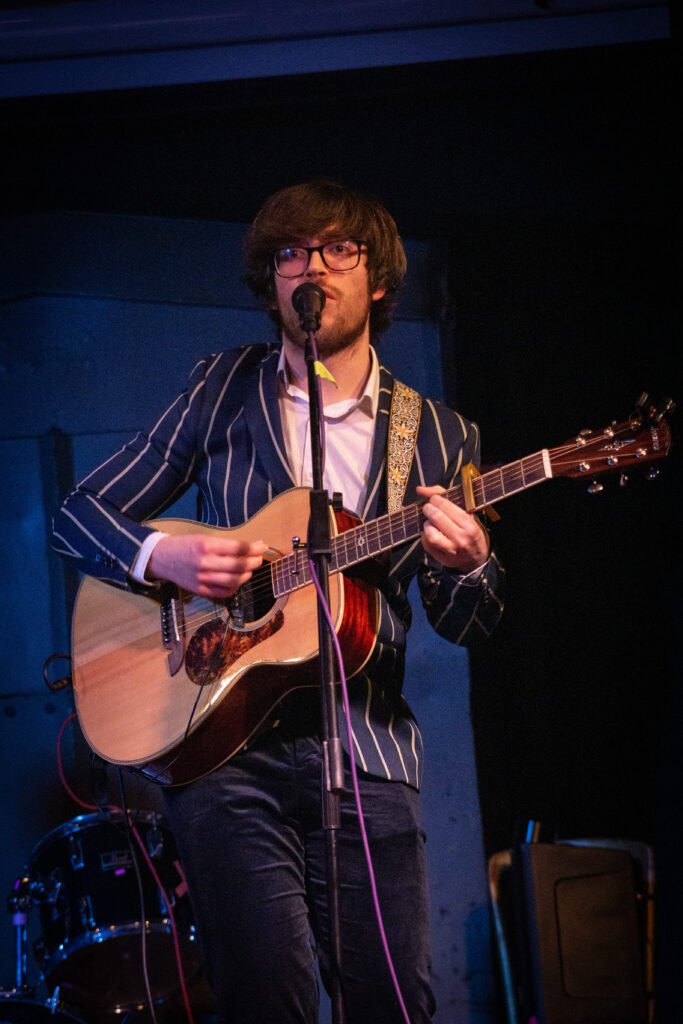
Encore! is Frederick Bloy
- I am a Lancaster University graduate, attaining a First in English Literature, Creative Writing and Practice.
- I have since completed a PGDL law conversion with commendation.
- I hold 3+ years of experience tutoring young people between the ages of six to fifteen, in both groups and 1-to-1. My students boast impressive exam results, including those achieved for the St Olaves entry tests across multiple cohorts.
- I hold 2+ years of experience as an independent musician, releasing several projects and performing regularly across London as one half of the band 'Idiotwin'.
- Prior to Idiotwin, I encountered the power of creativity for young people as a member of the ArtsTrain project, which brought together young musicians to collaborate and perform. The liberty and unity of the experience was life-changing.
- My own experiences have shown me the power and support that the creative arts can provide. From my own time spent as a student, to the working world, they have provided me with a freedom, mode of expression, and way of supporting my mental health. It is all of this that I want to share with young people. It is why I have founded Encore!.
How does Encore! ensure young people are given what this research demands?
- By practising musicianship, which encourages experimentation and collaboration.
- Through creative writing, which brings thoughts and feelings into the physical world.
- Public speaking practice, which champions individuality and tackles anxiety and low self-esteem head-on.
- By providing a safe-space for imaginative play, where experimentation is rewarded.
- By encouraging open-ended discussions where creative thinking can be modelled.
- By examining problem-solving and its application in different areas.
- Interpersonal exchange and conversation, where contrasting ideas can happily coexist.
- Improvisation and performance, with praise for the unexpected.